
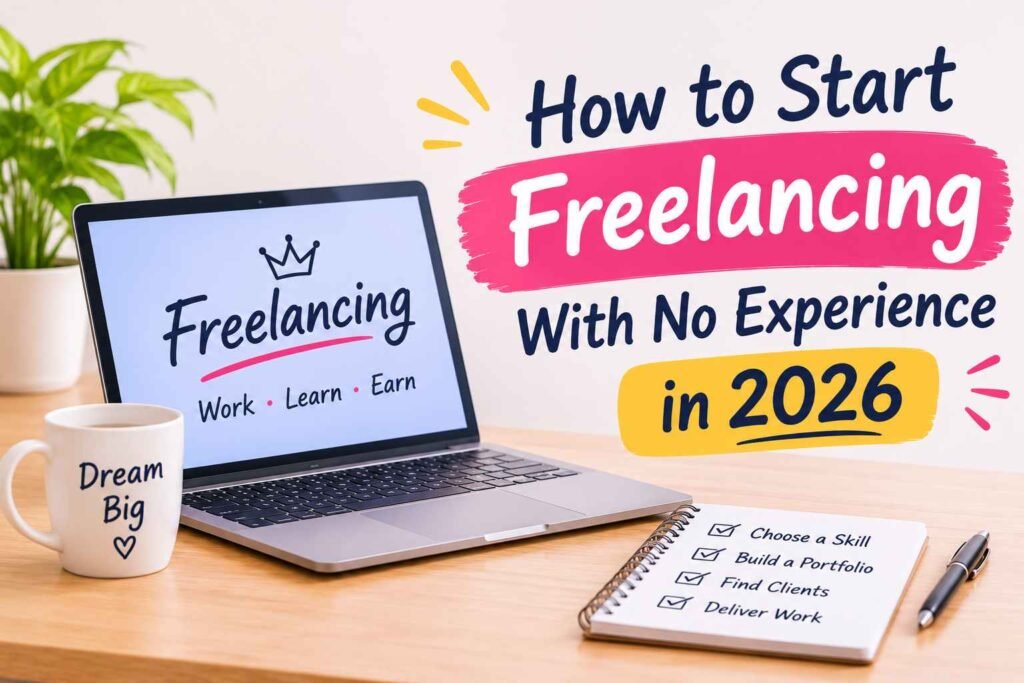

Wondering how to start freelancing without a degree or work experience? The best way is to learn one useful skill and take your first step.
Freelancing gives you the chance to earn money online and work with clients around the world. You can also learn new skills and work from home. But getting started can feel difficult when you have no experience.
The good news is that you don’t need a degree, a long resume, or a lot of money to start freelancing. You need one useful skill, a few samples of your work, and a simple plan to find clients.
You don’t have to know everything before you begin. Start with what you know, keep learning, and focus on solving real problems. Whether you’re a fresh graduate, a student, or someone looking for extra income, this guide will help you get started in 2026.

What Is Freelancing, and How Does It Work?
Freelancing means working for clients on your own. You are not a full-time employee. You might write blog posts, design graphics, edit videos, build websites, or help with daily tasks.
For example, a small shop may need ten Instagram posts each month. It cannot pay a full-time designer. A freelancer can make those posts for an agreed fee.
Here is how it works:
- Pick a service you can deliver.
- Make samples that show your skills.
- Find people who need that service.
- Agree on the price, deadline, and what the project needs.
- Finish the work, get paid, and build your name.
Freelancing gives you freedom. But you must also talk well with clients, stay organized, and work hard every day. guaranteed, especially when you are starting out.
Step 1: Choose a Beginner-Friendly Freelancing Skill With No Experience
Many beginners make one big mistake. They try to learn five skills at once. They spend weeks watching tutorials. But they never feel ready to offer a service.
Pick one skill instead. Think about three things: what you enjoy, what you can learn, and what clients need.
Best freelancing skills for beginners in 2026
| Skill | What you can offer | Useful starting tools |
|---|---|---|
| Content writing | Blog posts, website copy, product descriptions | Google Docs, Grammarly |
| Graphic design | Social media posts, flyers, simple brand graphics | Canva |
| Video editing | Short-form videos, captions, basic cuts | CapCut, DaVinci Resolve |
| Virtual assistance | Email organization, scheduling, research | Google Workspace |
| Social media management | Content calendars, post scheduling, engagement support | Canva, platform tools |
| WordPress assistance | Formatting articles, uploading content, basic website updates | WordPress |
| SEO assistance | Keyword research, content briefs, on-page optimization | Google Search Console, keyword research tools |
These are starting points, not guarantees of easy employment. Competition, client budgets, and demand vary by service and marketplace.
The World Economic Forum’s Future of Jobs Report 2025 identifies technological literacy, AI and big data, creative thinking, and adaptability among important evolving skills. This supports a practical approach: combine digital tools with judgment, communication, and a clear understanding of what a client needs.
How do you choose the right skill with no experience?
Ask yourself these questions:
- Do I like writing, designing, organizing, or fixing tech problems?
- Can I practice this skill every day for 30 days?
- Can I make three samples without a real client?
- Can I explain how this service helps a business?
Here are some ideas. Do you like writing? Start with product descriptions or blog posts. Do you like visual work? Try social media designs. Are you organized and good at talking to people? Virtual assistance could be a good start.
The goal is not to choose the most popular skill. It is to choose a useful skill you can develop into a reliable service.
Step 2: Learn the Basics Before Looking for Clients
You do not need to master an entire profession before accepting your first project. However, you should understand the fundamentals well enough to deliver work that meets a client’s expectations.
Start freelancing with free learning resources rather than purchasing several courses immediately.
You can use:
- HubSpot Academy for digital marketing and content-related learning.
- Canva Design School for design fundamentals.
- Google Skillshop for Google advertising and analytics training.
- WordPress Learn for website-building and publishing skills.
Pick one learning path. Then stick with it.
For example, say you want to learn content writing. In week one, learn how articles are built. Study headings, research, grammar, and what people search for. In week two, write short articles. Then edit your own work.
Do not spend months collecting certificates. A certificate shows you learned something. But clients want proof that you can do the work.
Use AI as an assistant, not a substitute for your skills
AI tools can help you start freelancing with no experience. They can give you ideas, help with research, build outlines, and suggest ways to improve your writing. But you must still check the facts. You must also follow the client’s rules and deliver good work.
A new freelancer who checks every output will often write better than one who copies AI text without a check.
Step 3: Build a Portfolio Without Professional Experience
Here is a common problem: clients want experience, but you need clients to gain experience.
The solution is to create sample projects that demonstrate what you can do. You do not have to wait for someone to hire you before building a portfolio.
Create three strong sample projects to start freelancing
Say you want to be a freelance content writer. You could make these samples:
- A well-researched blog post on a topic you know.
- A product description for a made-up online store.
- A landing page for an imaginary small business.
Want to be a graphic designer? Make three social media posts for an imaginary cafe. Add a flyer for a local shop. Then make a small campaign with the same look and feel across all pieces.
Want to edit videos? Make short sample videos. Use footage you own or have permission to use.
Add a short note to each sample. Explain the goal, your steps, and the final result.
Be honest. Label your own projects as samples or concept work. Never make up clients, reviews, or businesses.results.
Where should you display your portfolio to start freelancing?
You can start with a simple setup. Use a Google Drive folder, a Notion page, a personal website, or a profile on a freelance site.
Your portfolio does not need a fancy design. It should be easy to use. It should match the service you offer. And it should help a client judge your work.
The official Upwork freelancer profile guide also emphasizes presenting relevant skills clearly and avoiding exaggerated experience or work that belongs to someone else.

Step 4: Choose Where to Find Your First Client
Once you have a skill and a few samples, start looking for opportunities. You do not need to depend on one website.
Different platforms suit different working styles and services.
Freelancing platforms compared
| Platform or channel | Best suited for | What to consider |
|---|---|---|
| Upwork | Applying to posted client projects | Proposals may require paid Connects; fees and rules apply |
| Fiverr | Offering clearly defined services | You need a compelling service listing and discoverability |
| Professional networking and direct outreach | Relationships and consistent communication matter | |
| Direct outreach | Contacting relevant small businesses | Requires research, personalized messages, and follow-up |
| Personal website | Showcasing your services and portfolio | You must attract visitors and build trust |
These channels are not equally suitable for every freelancer. Test one marketplace alongside one direct-outreach method rather than trying to manage everything at once.
How to get your first client to start freelancing
Start by finding businesses that could use your service.
Say you offer social media design. Look for small businesses with messy or uneven posts. Make a sample that fits their needs. Then explain how you can help.
A simple message could look like this:
“Hi, I found your business page and liked your products. I make social media graphics for small businesses. I can share a few samples with you. If you want to improve your posts, I would love to talk.”
Keep each message short and personal. Do not send hundreds of the same message. Do not promise things you cannot do.
On freelance sites, read the job post with care. Then explain how you would solve that client’s problem. A thoughtful proposal beats a general message. Clients do not need to hear that you are hardworking and passionate.
Step 5: Set a Fair Price for Your First Projects
Many new freelancers make a pricing mistake. Some charge too little because they lack confidence. Others ask for prices they cannot back up.
A better way is to start with a clear project. Then figure out how much work it needs.
Your price should cover your time. For a first project, a small fixed price can keep things simple. The client knows exactly what they get.
But do not promise unlimited revisions. And do not take on work you cannot finish.
Step 6: Deliver Quality Work and Build Trust
Winning a project is just the start. Clients come back when you communicate well and deliver on time. They also tell others about you.
Before you start, get the requirements in writing. If something is unclear, ask. Do not guess.
During the project:
- Set deadlines you can meet.
- Share updates along the way.
- Stay within the agreed scope.
- Check your work before you send it.
- Take feedback in a calm, professional way.
- Ask for an honest review when the client is happy.
The key point is simple. Freelancing is not only about handing over a finished file. It is also about being someone clients can trust.
Step 7: Use a Realistic 30-Day Freelancing Plan
You do not need to quit your studies to start freelancing with no experience or existing job to begin. A consistent schedule can help you build momentum while keeping your financial risk manageable.
Here is a practical plan for your first month.
| Time frame | Main task | Target outcome |
|---|---|---|
| Days 1–7 | Choose one skill and study the fundamentals | A clear service direction |
| Days 8–14 | Practice and create sample projects | Three portfolio samples |
| Days 15–21 | Set up a profile and identify potential clients | A professional profile and targeted prospect list |
| Days 22–30 | Send tailored proposals, follow up, and improve samples | Consistent outreach and useful feedback |
These are activity targets, not a promise that you will earn money within 30 days. Some beginners find clients quickly; others need more time to improve their skills, positioning, or outreach.
A simple daily schedule to start freelancing
If you can dedicate two hours each day, try this routine:
- 30 minutes: Learn or improve your skill.
- 45 minutes: Create portfolio work or complete client tasks.
- 30 minutes: Research suitable clients and send personalized proposals.
- 15 minutes: Review progress and plan the next day.
Once you have paid work, prioritize deadlines and client communication over unnecessary course consumption.
Track a few simple numbers each week: proposals sent, replies received, meetings arranged, projects won, and completed work. These figures can help you identify where your approach needs improvement.
Step 8: Avoid Freelancing Scams and Common Beginner Mistakes
The promise of earning money online attracts legitimate clients, but it also attracts scammers.
The US Federal Trade Commission warns about task scams that begin with unexpected messages offering easy online earnings and later demand deposits to unlock supposed payments. Read its official guide to identifying and avoiding task scams.
Protect yourself with these rules:
- Never pay a stranger to release your pay.
- Be careful with promises of fast or sure income.
- Do not do big unpaid work as a “test.”
- Use a written agreement. It should state the work, the pay, and the deadlines.
- On freelance sites, follow the site’s rules for chats, contracts, and payments.
- Check out the client first. Verify odd requests before you share private details.
Also avoid these common mistakes:
Learning without practicing: Every week should produce something you can show or use.
Offering too many services: A focused offer helps clients understand why they should hire you.
Copying other freelancers: Study their positioning, but create original samples and communicate your own strengths.
Giving up after a few rejections: Review your proposals and portfolio before deciding that freelancing is not for you.
Relying on one platform: Over time, diversify your client sources so your business does not depend entirely on one marketplace.
Frequently Asked Questions
Can I start freelancing with no experience in 2026?
Yes. You can start without a job history. You need a useful skill. Then you show it through sample projects. Your first goal is to prove what you can do. You do not need to pretend you have years of work behind you.
Which freelancing skill is easiest to learn with no experience?
No skill is easiest for everyone. Some beginners find Canva design, basic virtual assistance, or simple content formatting a good place to start. Your best choice depends on what you like, what you already do well, and what clients need.
Can I start freelancing without experience for free?
Yes. You can learn with free resources. You can also build a basic portfolio without a costly course. But some sites charge service fees. Some ask you to pay for credits to apply. Later, you may also need good equipment or paid software.
How long does it take to earn your first freelance income?
There is no fixed timeline. It depends on your skill, portfolio, pricing, outreach, competition, and the type of service you offer. Focus on measurable weekly progress rather than expecting guaranteed earnings by a particular date.
Do I need a degree to become a freelancer?
Many freelance services do not require a university degree. Clients may prioritize practical skills, relevant samples, communication, and reliability. Some specialized fields, however, require formal qualifications, licenses, or specific professional experience.
Conclusion: Start Small, Learn Consistently, and Keep Improving
Learning freelancing with no experience takes a few steps just build skills show your work and find the right clients. And you get better with real projects.
You do not need a perfect plan before you start. Pick one service. Make three strong samples. Build a clear portfolio. Then spend time each week reaching out to possible clients.
Your first project may be small. Your first few proposals may get no reply. That does not mean you will fail. Use any feedback to improve your work and make your offer better.
Your next step: Pick one freelancing skill today. Then make your first sample this week.
Did this guide help you? Share it with someone who wants to build career skills or earn money online. Find more tips on learning and careers at SkillGrantia. Leave a comment and tell us which freelancing skill you plan to learn first.